
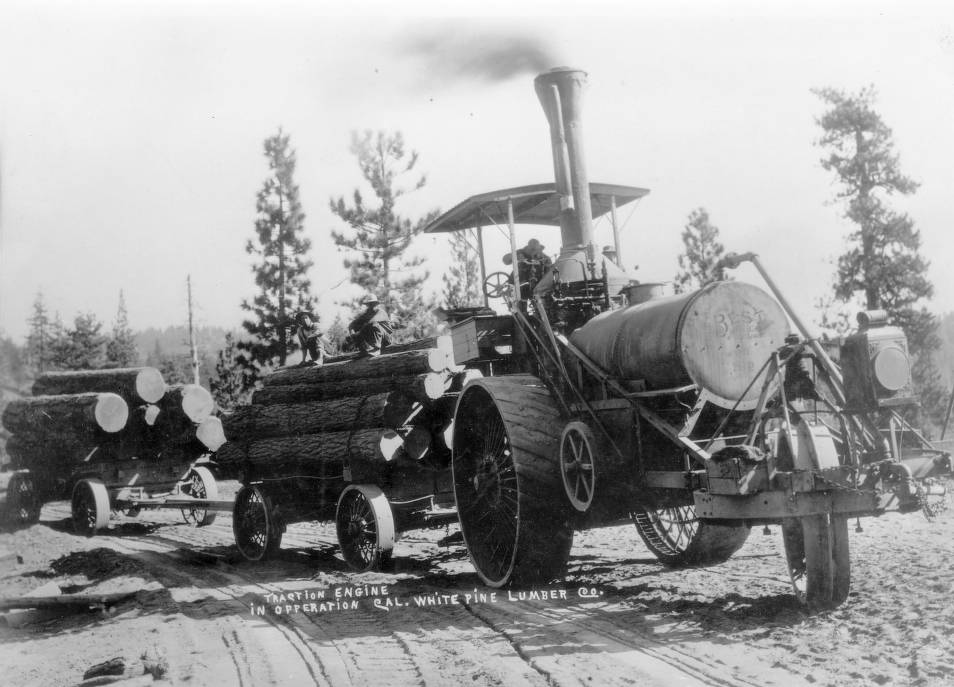
The history of the C.L. Best Tractor Company is deeply rooted in the legacy of Daniel Best, an early innovator who began developing steam and gas tractors in the late 19th century [3, 5]. In 1908, Daniel Best sold his company to his rival, Benjamin Holt, and his son, Clarence Leo (C.L.) Best, initially worked as the manager of Holt’s San Leandro plant [3, 5]. However, C.L. Best, who had been brought into the family business at age 13, left in 1910 to form his own entity: the C.L. Best Gas Traction Company [3, 5].
This move, intended to continue the work pioneered by his father, sparked a fierce rivalry between C.L. Best and the Holt Manufacturing Company [5, 11]. By the end of World War I, Best’s company boasted superior financial status and more advanced tractor designs compared to Holt [5]. In 1925, the two rivals merged their interests to form the Caterpillar Tractor Co., with C.L. Best serving as the chairman of the board until 1951 [3, 5].
Upon establishing the C.L. Best Gas Traction Company in 1910, C.L. Best launched his independent manufacturing venture with a focus on traditional wheel-type traction engines before transitioning to the track-layer designs for which the company later became famous [5, 11]. These early machines, produced between 1910 and 1916, represented Best's initial challenge to the Holt monopoly [3, 6].
Production of these round-wheel tractors took place at the company's first plant, located in Elmhurst, California, as well as in San Leandro, California [6, 11, 5]. According to antique machinery records, the production run for these "Best Round Wheel Tractors" included serial numbers 1-RW through 105-RW [6].
These machines were massive, high-horsepower units designed for heavy agricultural work on large Western farms [3]. They were powered by internal combustion engines—specifically Buffalo engines—rather than steam, with power outputs ranging from 40 to 90 horsepower [3, 6]. One surviving example of this era is a notable 1911 75-horsepower round wheel tractor, which was owned by the Shank family and is located at the Pioneers Museum in Imperial, California [5, 6]. These wheel-type models were offered alongside the later track-type machines for a short period [13].
Although C.L. Best started with round-wheel models, his time spent developing them was remarkably short, serving as a brief but critical step in his engineering development [5]. The company began working on a new track-type tractor design within a few months of its founding [5].
By the end of 1912, only two years after forming his company, Best had his first track-type machine, the Best 70 Tracklayer, ready for production [5]. This design featured a rear track and a front tiller wheel [3]. This swift transition cemented the company’s reputation as an innovator in crawler technology, ultimately leading to the success of its famous Tracklayer models and the eventual 1925 merger with the Holt Manufacturing Company to form Caterpillar [5, 15].
While C.L. Best's company focused on gas traction, the design lineage traces back to the steam tractors built by his father, Daniel Best. A notable example is the 1905 Best Steam Tractor, a massive round-wheeled machine used for logging [7]. This steam engine possessed a 110-horsepower drawbar capacity and a top speed of 4.5 miles per hour [7]. It featured variable cut-offs allowing the operator to change speed and was capable of sucking 55 gallons of water per minute into its boiler system using a vacuum hose [7]. These "big wheels" on the steam tractors were the direct precursors to the track systems that would eventually dominate the industry [7].
The Daniel Best steam tractors were widely used in North America for agricultural tasks such as threshing and plowing, with some models capable of pulling 30 or more plow bottoms [1]. Although the steam engine was gradually phased out by the mid-1920s in favor of internal combustion engines like those developed by C.L. Best, the immense pulling power and round-wheel design of these early steamers laid the groundwork for future traction technology [1].
Serial Numbers or “Tractor Numbers” for Best Model Tractors have the following “Letter” at the beginning or end of the serial number.
If the number on the tractor does not include the right “letter” for the model of tractor then it is the Royalty number.
The serial number and royalty number may or may not have the same number of digits, in most cases the serial number will be a lower number than the royalty number.
The royalty number is located on the brass tag with the patent numbers listed, the tag is sometimes mounted on the fenders.
The serial number is located on a tag that reads “Tractor Number”, which is located in the following locations:
The list below has been generated from information we have received from machinery owners and from different publications
1889 Serial No. 3 Towle Bros. Texas Hill, CA, USA. Wrecked Machine with parts missing
1894 Serial No. unk. Furnace Creek Ranch, Death Valley, CA, USA. Nickname "Old Dinah" un-restored non-operational
1894 Serial No. unk. Las Vegas, NV, USA. un-restored non operational
1903-1906 Serial No. unk. Angles Camp Museum, Angles Camp, CA, USA. un-restored non-operational
1905 Serial No. unk. Yukon-Charley Rivers National Preserve, Alaska, USA un-restored non-operational
1906 Serial No. 175 Joe Heidrick Sr. Foundation, Woodland, CA, USA. restored operational
1906 Serial No. 185 Roots of Motive Power, Willits, CA, USA. restored non-operational
1906 Serial No. 188 Ken Eder, Carthage, NC, USA. restored operational
1909 Serial No. unk. Holt Caterpillar, Houston, TX, USA. un-restored operational
1910 Serial No. 242 Smith Park, Rexburg, ID, USA. un-restored non-operational
1910 Serial No. unk. Phillips Brothers Mill, Oak Run, CA, USA. un-restored operational
1911 Serial No. 295 Phillips Bros. Mill, Oak Run, CA, USA. un-restored non-operational


